
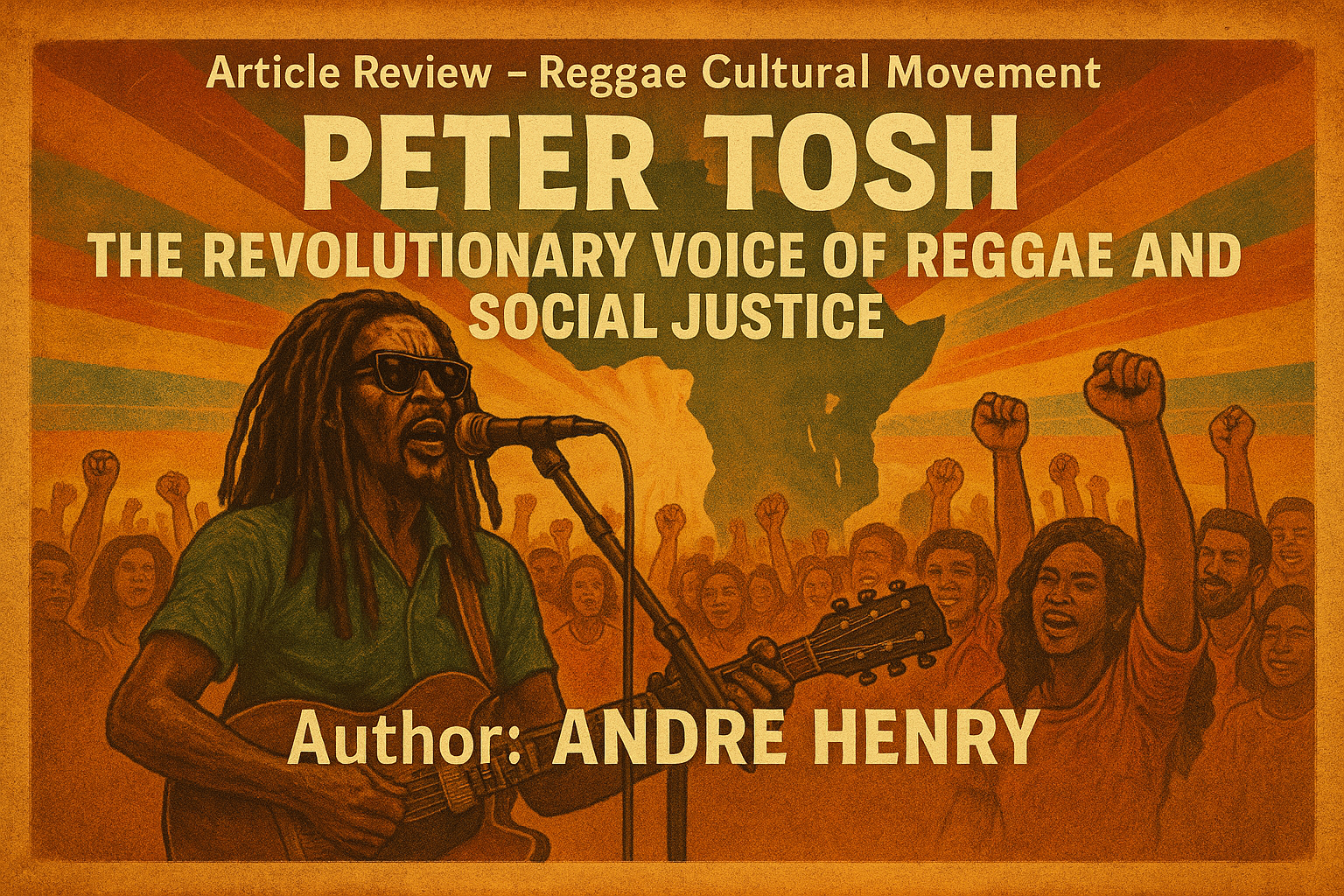
1️⃣ Introduction – A Voice Raised in Truth
In the feature titled “Peter Tosh: The Revolutionary Voice of Reggae and Social Justice,” writer Andre Henry offers an incisive exploration of Peter Tosh’s role not simply as a musician, but as a militant prophet of reggae culture. The article, published by The Reggae Museum online on October 20, 2025, traces Tosh’s trajectory from Kingston streets to global stages, emphasizing his unflinching commitment to justice, African identity, and spiritual liberation. THE REGGAE MUSEUM
Henry’s piece shines because it places Tosh within the larger movement of reggae as culture, resistance and spiritual awakening. For readers of Reggae Cultural Movement, it offers rich material that aligns with the values of truth-telling, African consciousness and roots legacy.
2️⃣ Summary – From Rebel Musician to Revolutionary Icon
Henry structures the article around three core themes:
● Militancy and social justice
Tosh’s music became a weapon against oppression. Henry recounts how Tosh confronted Jamaican authorities during the 1978 One Love Peace Concert and how songs like Equal Rights and Legalise It defined his political voice. THE REGGAE MUSEUM+1
● African identity and Rastafari philosophy
The article emphasizes Tosh’s unwavering embrace of African identity — his alignment with Pan-Africanism, his reverence for Ethiopia, his use of reggae as a tool for Black sovereignty and self-determination. THE REGGAE MUSEUM
● Legacy and ongoing relevance
Henry argues that Tosh’s mission transcends his death in 1987. His music continues to fuel global movements for cannabis reform, racial justice, and cultural dignity. THE REGGAE MUSEUM
Important details from the article:
- Tosh’s assault by police in 1978 deepened his resolve. THE REGGAE MUSEUM
- The article credits him with using art as activism, positioning him as a “freedom fighter with a guitar.” THE REGGAE MUSEUM
- It celebrates the continuation of Tosh’s message in the digital age and in global justice campaigns.
3️⃣ Reflection – Why This Matters to Reggae Cultural Movement
At Reggae Cultural Movement, we are always searching for reggae’s authentic roots and its current pulse. Henry’s review of Tosh’s life offers precisely that: an unfiltered look at reggae as political theology, spiritual discourse, and cultural architecture.
Here are some key reflections:
📌 First – Tosh reminds us that reggae was never meant to be mere entertainment. The article underscores how reggae emerged from systemic injustice, colonial history, and emancipatory struggle. For our readers, this reinforces that reggae culture demands active engagement, not passive consumption.
📌 Second – The emphasis on African identity aligns with our movement’s mission. Tosh embodied the reclamation of African dignity through music. Henry rightly highlights how Tosh carried the Black liberation message forward — from the lyrics of “Africa” to the demand for equal rights.
📌 Third – Legacy matters. Henry’s article shows that the work of artists like Tosh is still relevant. Reggae’s spiritual and political power continues to manifest in movements across Africa, the Caribbean, and the diaspora. This reminds us this culture is alive, evolving, not frozen in nostalgia.
📌 Fourth – For younger generations exploring reggae, this article serves as a beacon. Tosh is less commercially packaged than others and thus his radicalism challenges music consumers to dig deeper. Henry’s piece invites that investigation.
In short, Henry’s article sits as a strong companion for anyone working within or alongside this culture. It aligns with our values: authenticity, resistance, spirituality, and African-rooted consciousness.
4️⃣ Highlights & Quotables
Here are some standout moments from the article that deserve emphasis:
“In the beginning was the beat … then there was the bass.”
— this phrase frames how Henry understands reggae not just as music, but as cosmic creation. THE REGGAE MUSEUM
“Everyone is crying out for peace, yes — none is crying out for justice.”
— a lyric by Tosh, cited by Henry to highlight how reggae’s gospel is not passive, but active, demanding change. THE REGGAE MUSEUM
“Tosh used art as activism and never backed down from truth.”
— Henry’s summary of Tosh’s life and legacy. THE REGGAE MUSEUM
These passages reaffirm that reggae culture must be read and reckoned with as spiritual, political, and cultural texts — not simply audio.
5️⃣ Constructive Notes
While Henry’s article is powerful and well-researched, a few observations for our community’s sake:
- Depth of African context: The article touches on African identity, but could deepen the exploration of how Tosh’s music reached Africa, influenced African reggae scenes, and was shaped by African diasporic return philosophies.
- Musical analysis: Tosh’s sound — his guitar work, riddims and production choices — deserve more attention as part of his revolutionary toolkit. Henry mentions them, but a deeper breakdown would enhance understanding.
- Contemporary echo: While Henry touches on legacy, a fuller examination of how modern Brazilian, African or Pacific reggae artists draw from Tosh would strengthen the global relevance.
These are minor critiques in a strong piece. For our readers, they present opportunities to link Henry’s work into broader features.
✅ Final Verdict
For the Reggae Cultural Movement audience, this article is highly recommended. It provides:
- A focused and meaningful biography of Peter Tosh.
- A clear articulation of reggae’s spiritual, political and cultural dimensions.
- A bridge between Jamaican roots and global resonance.
We thank Andre Henry for illuminating the revolutionary voice of Peter Tosh. His piece not only enriches our historical understanding but also inspires us toward ongoing activism, cultural affirmation, and spiritual renewal.
Reggae Cultural Movement believes:
💚💛❤️ One Movement. One Culture. One Love.
Read this article and let the revolutionary rhythm of Peter Tosh move you toward truth, justice and freedom.

